What’s your Plan B right now? If everything went pear-shaped, what could you do?
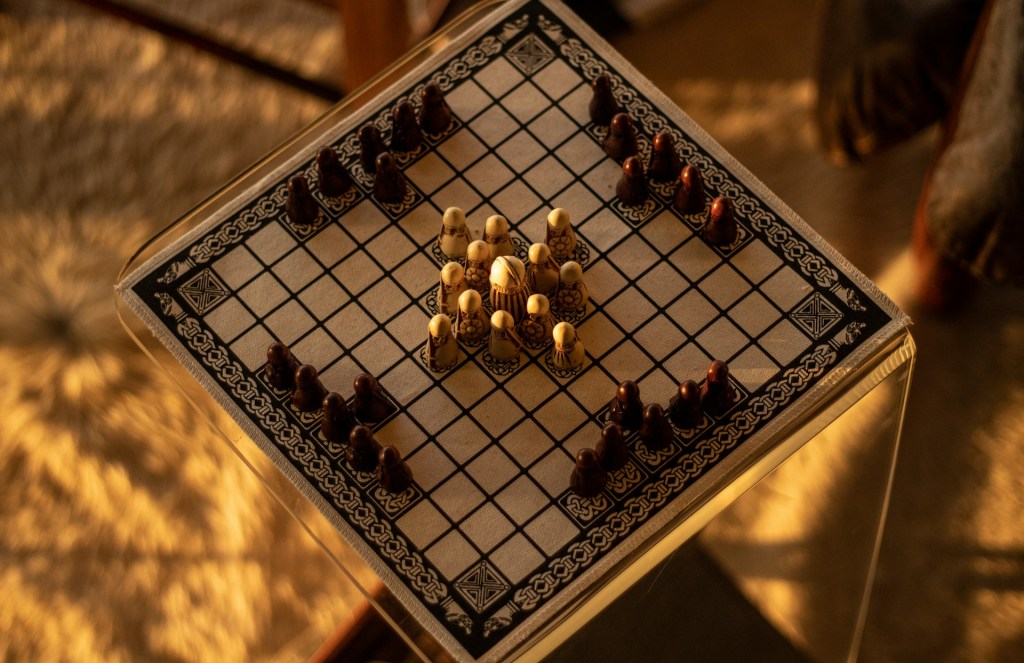
The ancient Welsh played board game called tawlbwrdd, one of a pan-European family of ‘tafl’ games. It’s sometimes called “Viking chess”. Unlike modern chess, the two sides are unequal.
At the centre of the board stands a King, in the midst of his twelve bodyguards. Arrayed around the edges of the board are twenty-four enemy pieces, who must prevent the King’s escape, which he can only do by reaching one of the four corner squares. The player controlling him has to achieve this by expending assets – that is to say, the bodyguard – to open up a path to freedom. It’s a game of strategic competition as each player tries to create the conditions needed to win. (See here for a short video introducing the game).
My article on Bylines Cymru: Sensemaking at Slebech takes a look at Owain Glyndŵr, the last true Prince of Wales. In 1400 he inspired a national rebellion in Wales, giving a people a dream of independence that they were willing to fight and die for. The forces arrayed against them were too powerful, though, and their resources too few.
The rebellion failed. Glyndŵr himself was not seen after 1412. What happened to him? There were rumours, but no certain news. In my article, I discuss his role in the national myth that inspires contemporary Wales – but myths are the folk memory over generations of decisions and actions of the far past. Memories of people in the far past who reviewed their goals, took stock of the forces acting around them, reviewed the resources available to them – and made their plans accordingly.
As it became obvious that the rebellion would not succeed, Glyndŵr needed to decide what to do. If he just carried on doing the same things he would probably end up captured and executed: hung, drawn and quartered in a very slow and very painful death.
He needed a Plan B. As I discuss in the article, he had few good options. Nevertheless, he still had some options. He still had assets in the form of his experience and knowledge. He still had a path to freedom, despite the forces arrayed against him, because there were people who needed those assets. These were the Knights Hospitallers.
I argue that this would have led the Hospitallers to take Glyndŵr to either Rhodes or Türkiye. Not what he originally planned. Not what he originally wanted. But, a Plan B which became the best option after everything went pear-shaped.
A decade or so ago, I was hired as a senior lecturer at a British business school, with the specific responsibility of helping overseas students, mostly from China, adapt to British academic life. I realised that one of the biggest problems they faced was to do with language. So that I could understand the issues better, I trained to become a qualified teacher of English as a Second or Other Language. When toxic organisational politics drove me and many other lecturers to resign, my career in academia collapsed.
Fortunately, I had that Plan B. I became an English teacher in Russia. Although I was earning a pittance compared to my lecturer’s salary, I was at least working. And, I was gaining invaluable personal experience of life in Russia. I got to know ordinary Russians from all walks of life: from corporate managers to university lecturers to university students to dockworkers. Ordinary people, learning English because they thought it would help them in their careers.
A year later, my profile led to me being head-hunted by the British Council in China, for a job which paid more than I’d ever dreamed of – until everything went pear-shaped again with the Covid pandemic. That’s another story, though.
The point is: everyone needs a Plan B. It mustn’t be wishful thinking. It needs to be grounded in a serious analysis of what you have in terms of assets, and of the obstacles arrayed against you.
This isn’t just some general point. The UK has just gone into recession. The EU isn’t doing any better. Between rising energy prices, supply chain problems, new trade barriers, Brexit, and a host of other factors, it should be becoming very clear that a lot of people are going to be losing their jobs, and finding a new one is going to be tough.
More than that: the world is changing. Life in western Europe is never again going to be as affluent as it has been in the last half-century.
We might not be threatened with being hung, drawn and quartered. Many people are, however, likely to be facing the loss of their incomes and careers. Often unexpectedly. Often suddenly.
So: do you have a Plan B ready to go? If you don’t, and you don’t know where to start – well, perhaps it might be worth talking to a coach.
Photo by Vinicius “amnx” Amano on Unsplash
 Traethiad