Unexpected travel due to family issues mean I only have time for a quick post this week. Back to longer-form next week!
I’m a sucker for second-hand bookshops and charity shops. Can’t walk past. Over time, one gets to know which places get quality books – though, of course, your definition of ‘quality’ may differ from mine!
I have my specialist subjects, in which I’m always looking for a rare old book. I was incredibly pleased last year, for example, to find a copy of the 1870 edition of William Owen Pughe’s Myvyrian Archaiology of Wales, with all three volumes collected in one binding, for only £100. That’s an excellent price for something so rare – and an amazing stroke of luck to find it in a charity shop!
At other times, I find books which are just a bit odd. Books which are so ultra-specific as to be an intriguing insight into a very different mental universe. Historical ephemera which give a glimpse into a vanished world. I tend to collect these in the same spirit that I collect vintage travelogues: for insights into a culture which is not only alien, but which is gone; slipped out of our grasp in the torrent of years.
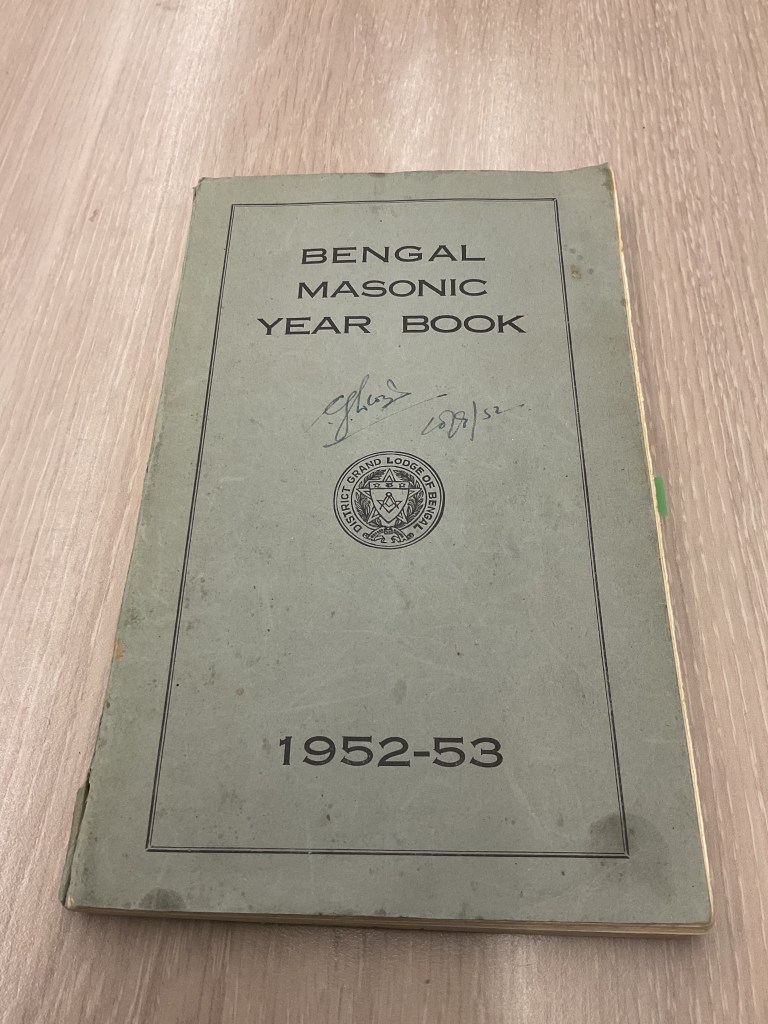
One of these is the book in the photo, which I found earlier today: The Bengal Masonic Year Book 1952-53.
Why is this interesting? First of all: Bengal. It’s where the East India Company first established itself; where the intertwining of British and Indian histories began. It’s where my fellow Welshman and Welsh-speaker William Jones sat as a judge and compiled the first formal digest of Hindu and Muslim law in Sanskrit; it’s where he founded the Asiatic Society of Bengal and where he propounded his theory of a family of languages derived from an Indo-European original. (I write this, of course, from the perspective of a Briton and Welshman who hasn’t been to India. I’m aware that the British presence was often malign, including the 1943 Bengal Famine).
Secondly: the year. The yearbook runs from 1st July 1952 to 30 June 1953. Queen Elizabeth II had been crowned just a few months before; this was her first year as monarch of the UK and the Commonwealth. India, having become independent in August 1947, was finding its feet as a sovereign nation; 1952 was the year of its first elections under its post-independence constitution.
Thirdly, of course, this isn’t a book in general: it’s a particular copy which once belonged to a particular individual. Like so many of these old books, there are underlinings, ticks, and obscure annotations. All of this was important to someone once. Who? Why? How did it come to be in a charity shop in Wales? We can only speculate and imagine.
The Bengal Masonic Year Book 1952-53 of the District of Bengal, then, represents a microcosmic history, running from the arrival of the British – the first Masonic Lodge was established in Bengal in 1728/1729 – to their departure. Freemasonry regarding all men as brothers, it’s interesting to see amongst the yearbook’s membership rolls how many times names like Rai, Shah, Sorabjee, Prasad, Gjose, Mukerjee, Basu, Gupta or Ismail appear amongst the names of lodge or district officers – and that’s just a random selection from a handful of pages; there are many other Indian names.
The pages of the yearbook are scattered with inspirational quotes. Some are corny as heck; some of them appear every now and again on social media even today. Others are very specific to Freemasonry. I liked this one, though, which is attributed only to “The Scottish Rite News”:
These Things I Know
I know that this day will never come again; it should therefore be the best day of my life.
I know that true happiness is a thing within and that when I begin to search for it I have it; when I get it and give it away again, it comes back double.
I know that work is a stimulus: it’s those who love in their hearts who are the doers and real benefactors of mankind.
I know that my life is exactly what I make it; only as I let other people and other forces influence me, do I follow them.
I know that if I live youth, I am young; if I live happiness, I am happy; if I attempt worthwhile things, I shall accomplish them.
I know there are those broadminded men and women who labour to make human society a symbol of human friendship.
I know that this world is not man’s only abiding place, else why the human aspirations which spring from our hearts and remain for a time unsatisfied.
In these times of division, it’s nice to imagine those expat Brits, Hindus and Muslims joined together in contemplation of this, just a few years after the tumult of world war, independence, and partition.
There you go: something positive to contemplate. Now, I have to run…
 Traethiad